Practicing Spiritual Rewilding After Moving
When I moved to Ireland, earlier this year, I shared an article about listening to new land. That piece was very much about the experience of relocation itself, about leaving one place and slowly arriving in another. What I have promised since then is an article that works more explicitly through the different pathways of Spiritual Rewilding, and how I have been living and practising them in this new landscape.
Spiritual Rewilding is not something I see as a set of abstract ideas or beliefs. It is a series of practices, approaches, and ways of being and seeing that support us in coming into belonging with place and allowing relationship with land to form over time. What I share here is a glimpse into how I have been working with these pathways here, as part of an ongoing process of belonging.
Wild Being, relaxing into place
Wild Being is one of the first modules we explore in the Spiritual Rewilding course. It looks at how we relax our state of being in place, how we shift our rhythm, and how practices such as nature mindfulness supports nervous system regulation and co-regulation with nature.
Before moving here, I was living in Canterbury. Although Canterbury is more of a small city, almost everywhere I went was accompanied by the sound and smell of traffic, lights flashing, roads, signage, and constant movement. There were plenty of trees, and many places where you could pause and ground, and if ever you found yourself somewhere without green life, you could always look up and see the sky and the clouds moving. We were also very fortunate to have nearby places where you could be surrounded by the more-than-human living world.
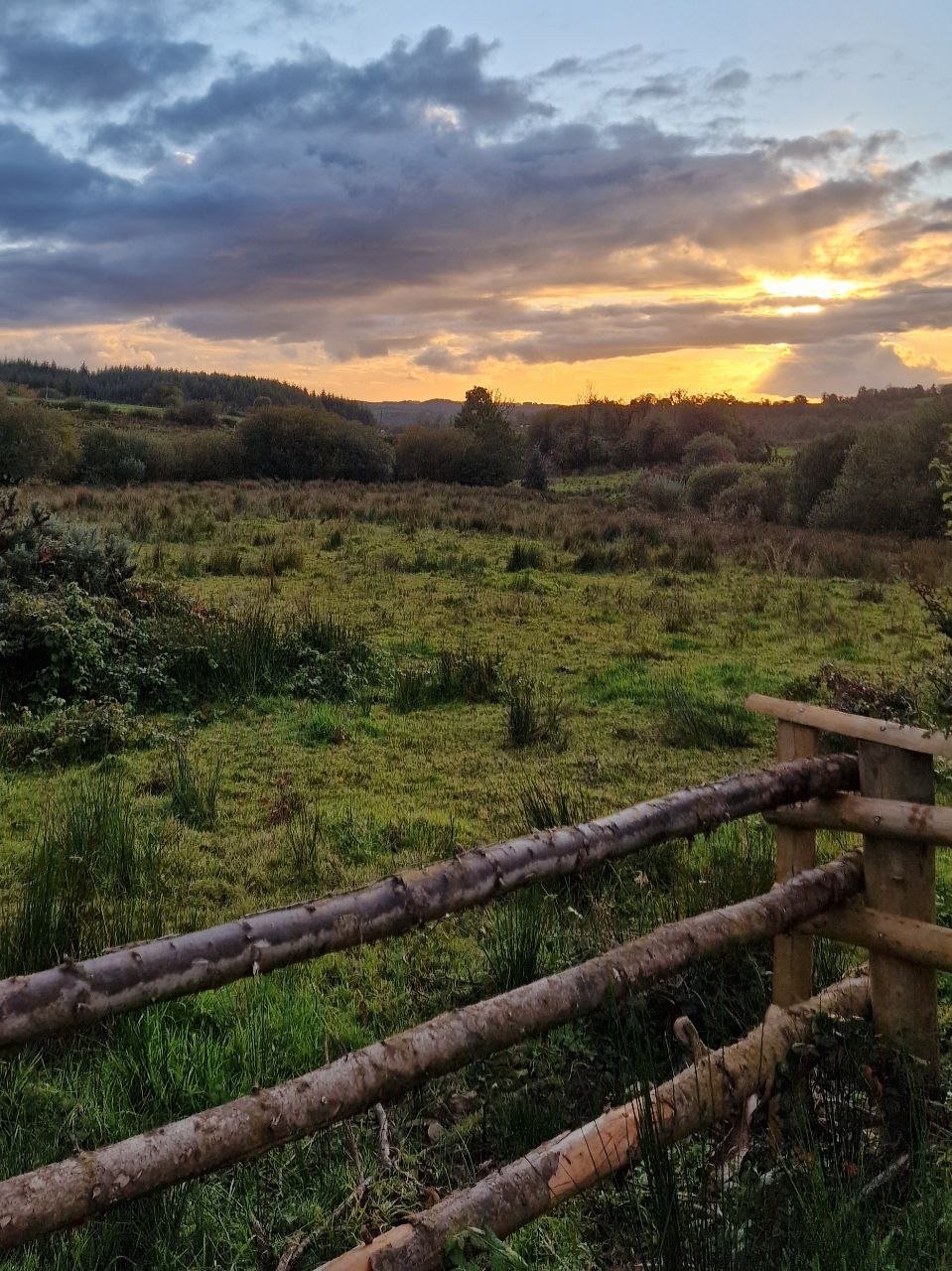
And yet, the difference here is striking. I live halfway up a mountain. In the far distance I can sometimes hear a road. Occasionally there is the sound of a tractor. But most of the time I am surrounded by birdsong, the sound of a mountain stream, and the wind in the trees. In autumn it was so peaceful that I could hear the sound of leaves falling.
What has been most interesting is not just the quiet itself, but how my attention behaves. Even here, my nervous system will immediately orient towards the sound of an engine in the distance. I notice my alertness rise. I then have to gently and deliberately bring my focus back to the birds around me, the trees, the water, the wind.
This has been a good reminder that Wild Being is not passive. Even in a place with such opportunity for settling, it remains a deliberate practice returning attention, again and again, to what is actually here.
Wild Rhythms, returning to cycles
Within Wild Rhythms, we explore the cycles of nature around us and within us, how they shift and change, and how we bring ourselves back into alignment with them. We learn about the natural world through observing how it responds to these cycles, and how that offers important teaching for us, especially in a culture that encourages us to live as if we should always be operating at one hundred percent, in a state of eternal summertime.
My move here deeply disrupted my own rhythms. As I reflected in my earlier article, in deep winter, when rest would have been natural, I was organising and preparing to move. In summer, a time often associated with celebration and gathering, I was saying farewells and marking endings. In late summer, when harvesting might be expected, I found myself in a period of new beginnings.
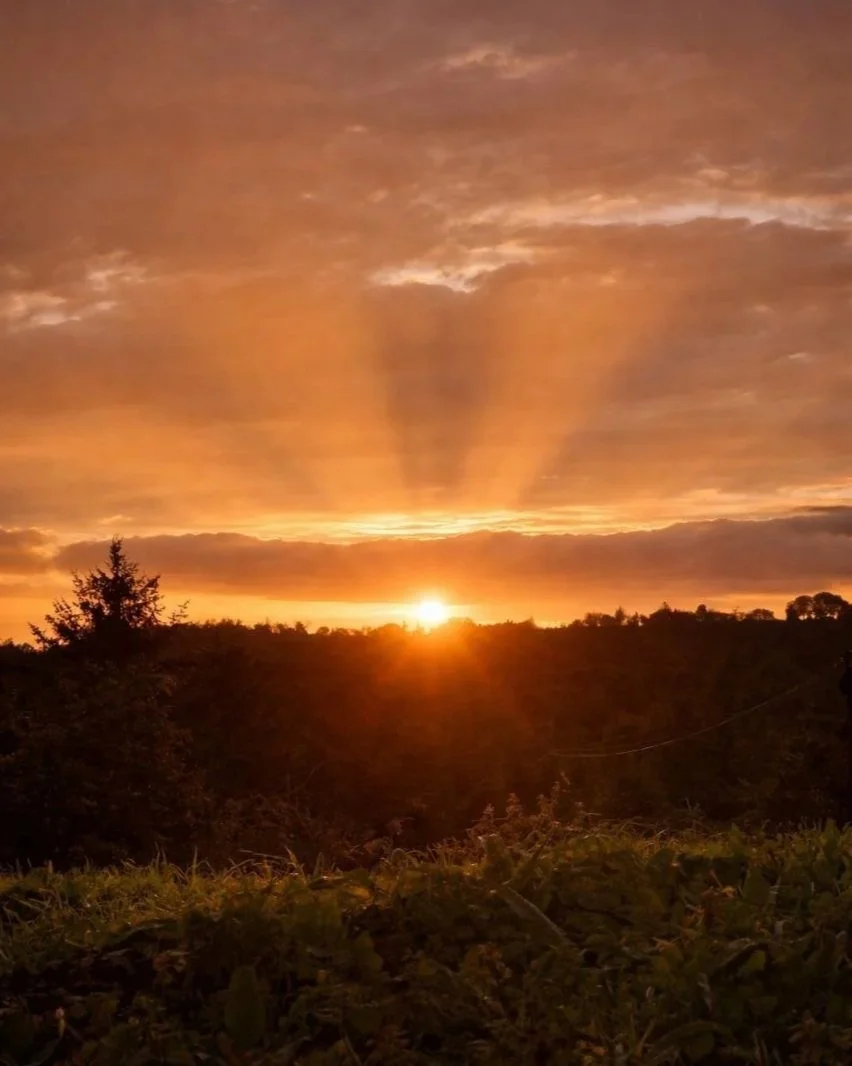
I am deeply grateful to the land here for gradually drawing me back into rhythm. Spending time with the seasons through autumn helped to realign me. I have been learning where the sun rises, how that point moves across the horizon through the year, and how the sunset shifts with the seasons. In planting my garden, I have had to observe how the sun moves across the sky, where warmth gathers, and where light lingers longest.
I have been watching the coming and going of birds, noticing migrations, and becoming aware of which presences are seasonal and which are constant. I have not yet been here for a full year, and that learning takes time, but even beginning to tune into these rhythms has been deeply healing after such a significant transition.
Wild Spirits, learning respect and relationship
In Wild Spirits, we begin to develop an animistic way of seeing the world, recognising the more-than-human intelligences around us and learning how to approach them with respect.
Here, I have worked with the practices we explore in the course, journeying to meet the spirits of this place, making offerings, and introducing myself. These journeys have not been about asking for anything, or seeking gifts or answers, but about arriving humbly and honestly, letting the land know who I am and that I am here. There are trees and spaces within the landscape that clearly respond, and several distinct spirits of place that feel open to deepening relationship.
The mountain I live on holds many old stories of fairies. Nearby there is a fairy fort, with very clear rules about how one should interact with it, and long-standing warnings about care, respect, and the possibility of mischief.
These stories are not treated lightly here. They reinforce something essential within animistic practice, that relationship with place requires attentiveness, humility, and an understanding that we are not in control.
Wild Stories, entering the storyscape
The Wild Stories module of the course invites people to explore folklore and myth, and join in co-creating such stories with the more-than-human beings around them. What has been particularly striking here is how alive local stories still are. Accounts from bygone generations remain present, stories of people who lived on this mountainside, of ghostly sightings, mysterious lights in the hills, and fairy lights seen moving across the land.
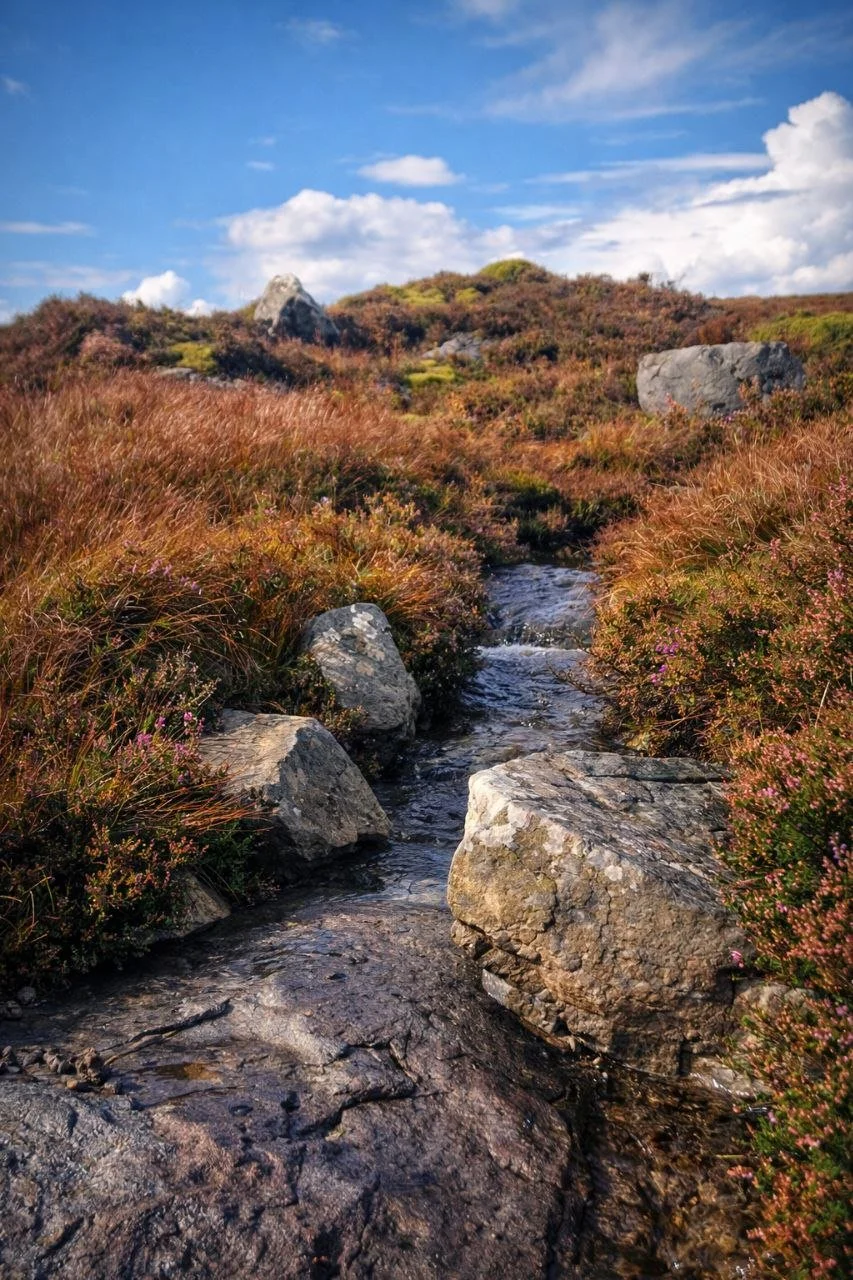
As I have been getting to know local waterways, I have also been learning their stories, of water maidens, water dogs like the Dobhar-chú of Glenade. Spending time at lakes, rivers, and hills is not just a physical exploration, but an entry into the storyscape of the place, and seeing it alive around me.
The land here is layered with narrative, and those stories continue to shape how people relate to it. Learning them feels as important as learning paths, names, and geography.
Wild Service, giving back to place
The Wild Service module asks how our relationship with land might move towards stewardship, protection, and action.
One of the first things I did after moving was to connect with a local ecological group, Our Native Glens. They organise regular projects including tree planting, seed saving, invasive species removal, river surveying, and other practical acts of care. Being part of this has been a meaningful way to begin supporting the area that now supports me.
Closer to home, I have been learning about the specific challenges facing local waterways and land. In Spiritual Rewilding, service is not separate from spiritual relationship. Listening to the land includes learning how to help amplify its needs and concerns in practical ways.
Wild Ancestors, may they be remembered
Wild Ancestors is a central pathway within Spiritual Rewilding. It invites us to remember those ancestors who lived in deep relationship with land, and to recognise how separation from land, through displacement, enclosure, and cultural rupture, continues to shape us. This work often carries an element of ancestral healing, reconnecting with ways of being that were disrupted, but not entirely lost.
Here, there is a strong sense of ancestral continuity in many areas. In places where families have lived on or near the same land for generations, stories of fairies, water beings, and spirits of place are still told, stories that may well have been shared by ancestors long before those living here now. While there has certainly been displacement and hardship, it is also clear that threads of connection to land have endured, held within stories, practices, and ways of speaking about place.
As someone arriving here from England, I am mindful of how I approach this work. Questions of ancestral connection, loss, and healing require care and time, and they are not something I am looking to rush. This feels like a place where listening, patience, and being guided by the land and by local context matter deeply.
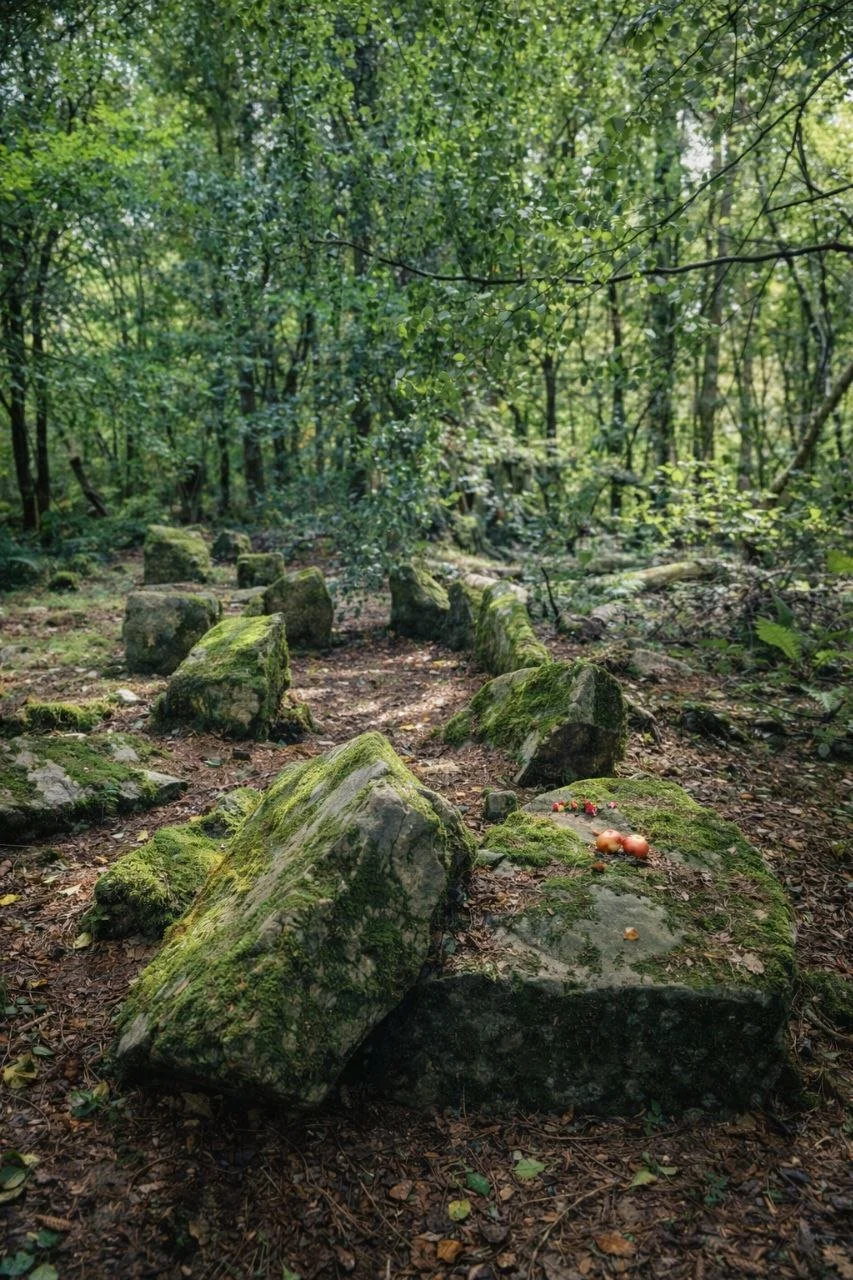
Alongside this, my interest in sacred sites has drawn me into relationship with the long-distant ancestors of this land. I have spent time visiting wedge tombs, cairns, giants’ graves, and old fields. These encounters offer another layer of connection, reaching back to those ancient ones who lived in right relationship with land. Sitting with these places has been a way of touching into the wisdom of the wild ancestors, and of inviting that wisdom to remain present and active now.
Wild Self, undoing and reforming who we are
Wild Self is the first module we explore in the Spiritual Rewilding course, and yet is the last one that I come to here in this article. It looks at different ways of understanding the self in relation to land, moving away from the idea of the self as separate, bounded, and autonomous, and towards a more relational sense of who we are, shaped by place, ecology, and relationship.
For me, moving to a new landscape has made this work very tangible. There is something deeply unsettling about arriving in a place where your familiar reference points no longer hold. Ways of being that made sense in one landscape do not always translate directly into another. In that sense, moving has involved both an undoing and a reforming of self, a gradual reshaping that comes through opening oneself up, through not knowing, and through allowing the land to have a say in who I am becoming.
This feels like a rich and complex area of practice, one that deserves more space than I am giving it here. It is something I will return to in more depth at a later point, as the relationship with this place continues to unfold.
An ongoing practice
What I have shared here is not a finished story, done and dusted, but a glimpse into how I have been working with the pathways of Spiritual Rewilding as I settle into this new land where I am making my home. These approaches are available to all of us who are seeking a living, grounded connection with our local landscape, and it is an ongoing, responsive, and continually unfolding process. I look forward to sharing more of this journey as it continues.
If you are interested in exploring these pathways more deeply, the next iteration of the Spiritual Rewilding course will begin in January 2026.